Showing posts with label Share. Show all posts

Friday, September 13, 2024

Manaiakalani Reading Practice Intensive - Sharing - Day 9

 My class tends to see blogging as a requirement and not as an opportunity to learn further. It is beholden upon me to turn this around, to embed it into our work and also to get them to reflect better.

We have sentence stems laminated and on every single chromebook.Nearly every time we blog, I get the same questions “how many stems do we have to do” (nothing has changed, still the same amount), “what does this mean?” (explained EVERY time) and the waiting for me to type it out for them (which I do not). They see it as a chore, as they do a lot of work in the classroom. “Do we have to read ALL of this?”, YES. 


Another issue is the lack of participation and commenting from whānau despite notices, posts online on different platforms and discussions kanohi ki te kanohi with them. We aren’t particularly good at commenting on others’ posts either. I feel this will be a focus for term 4, learning to comment better and setting aside time each week to visit others’ blogs and to give good feedback on their peers’ posts. It doesn’t help that our teachers aren’t particularly good at commenting either on each others’ professional blogs or those of our tamariki, although we are changing this.


The tamariki do not see blogging as part of their learning. Being able to write coherently and reflectively on their blogging is reading and writing! To express themselves and to think about what they are learning is the cherry on the top and a way to accelerate learning if done often enough.


The biggest thing I need to do as a teacher is to actually timetable the time to A) complete a blog and B) to comment on other’s blogs. It is not enough to say “blog your reading” in the response to text or elsewhere because if they do not manage to complete the mahi, that is the first thing that falls off. It needs to NOT be a perfunctory “here’s my work” and that’s it. 
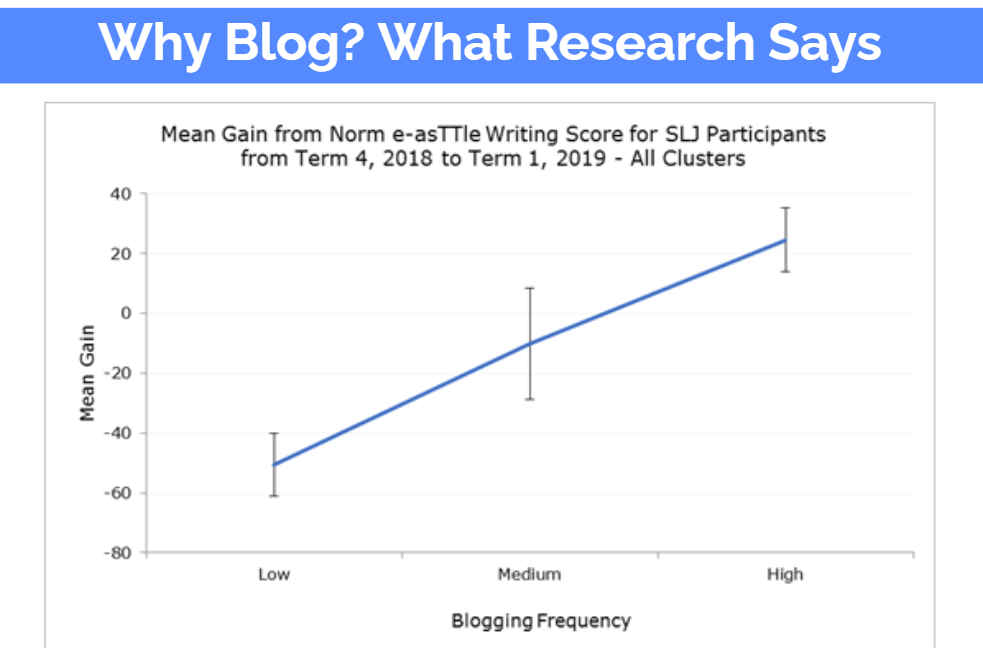

Research shows those tamariki who blog at a "high" level (2.5 posts on average per week) actually gain levels in asTTle writing scores. By writing and reflecting, they become better writers. This could be a game changer for some of my tamariki.


I currently have non-negotiable blogs (they HAVE to blog about something) but they are perfunctory reflections based on sentence stems we have provided. I am going to show them blogs from other schools that show how much more thinking has gone into their blog reflections.


I will also make a concerted effort to comment on their blogs more often. It is something if I don't timetable it into my life, it will not happen except in random bursts!


Another aspect of sharing we looked at today was collaboration. Completing "creates" with other tamariki in the class. I can see this sometimes going pear-shaped so I will need to set some ground rules with input from the tamariki as to how this will work and how they are held accountable in their pairs or groups. I will also be asking them how they would like to collaborate and creating success criteria with them around their dispositions and expected behaviour.


We blog about once a week at the moment and it happens at odd times. I will formally timetable these into the day and also have a time for them to post comments on others' work. Some have completed how to write a good comment, but I think all will actually benefit from another round of lessons on how to write great blog comments (along with blog posts!)  
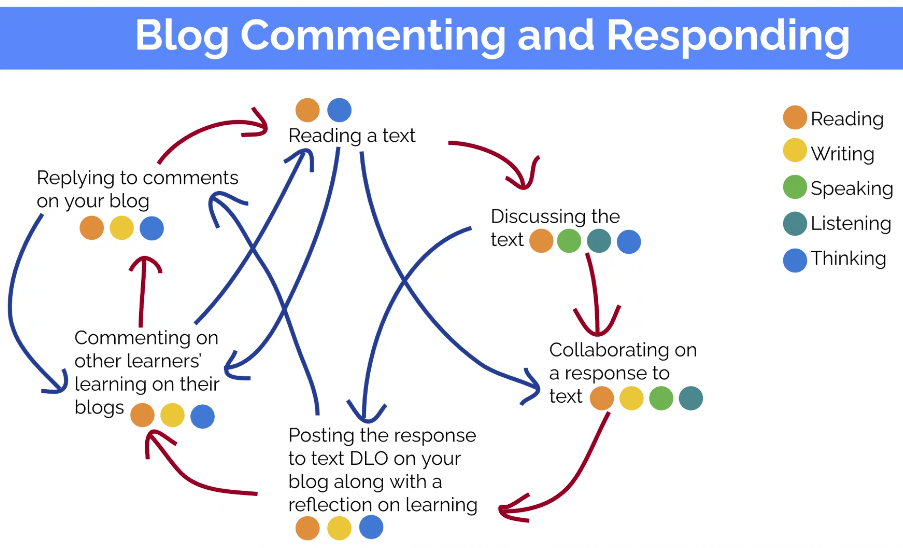

As the diagram shows, commenting and responding is not linear! But it hits all aspects of the curriculum with regards to English (as the curriculum currently stands anyway!) It is one way to help increase literacy time while doing something the kids usually enjoy.


My biggest area of concern though is the whānau engagement. i have two parents who comment on blogs. One is a high school teacher who understands the benefits of commenting (also a Manaiakalani school). How do I get others involved? I liked the ideas of sending home reading "homework" to do as a whānau. I will think long and hard about a few activities that whānau do not find difficult or time consuming to ensure they do want to do it and get it done. The kids won't be hard to convince but I don't want meltdowns at home if there is raru about having to do it.


It is the final day of the course, I am happy in one sense that I have achieved a lot on this course and that it is done. But I am also unhappy as there goes the accountability, learning, collaboration with teachers all over NZ and the myriad of other benefits being on this course has meant. I can't wait to get on the MPI and hopefully a writing version of this same course. Excited!!


Friday, August 20, 2021

DFI Reflection - Day 4 - Dealing with Data

This week the benefits of online learning came to the fore. Lockdown. A Level 4 shutdown of the whole country.  I think we all knew it was coming, but no one knew when. Doing DFI online has meant a seamless continuation of our course which is awesome. Pity my home internet didn't value my learning as much as I do!  It just didn't like running Meet with video enabled and anything else online. If I turned my video off it at times made a difference, but it is what it is and I wouldn't move just to get better internet!

We covered the SHARE part of Manaiakalani's pedagogy today. 

Since time immemorial we have shared our lives with others. At school it was through assemblies, school newsletters, school visits by parents and taking work home. Although this doesn't stop in the age of Manaiakalani, it is totally expanded with the advent of the internet and Blogging.

Part of the Hook of Manaiakalani is the SHARE:

"Work with learners to establish an authentic audience for their learning outcomes".

Sharing their work with a purpose, an authentic audience, getting feedback and having discussions on their work provides a great boost to the tamariki's self esteem and mana. In ordinary circumstances at school, no one really has a choice about hearing or seeing your work. It's either your teacher or the school/class in a compulsory situation. Online it it different. As Dorothy Burt said it is "people who choose to listen to you" online. They can easily click into another website and ignore you so any reads you get, any comments you receive are genuinely interested in your work - how motivating is that?!

We covered off three main areas today with regards to data:

  1. Forms
  2. MyMaps
  3. Sheets
I have used all three extensively before so it was nice to know a wee bit before we went through them as a group.  I use forms a lot in Guiding, and have used them in tests online for my tamariki, had them answer comprehension questions and find out information from our whānau.  Here is one I made on DFI - which was great as I was going to have to create it anyway. I kept it simple for our whānau, my audience. I had difficulty embedding it which I will try again later, but here is the link:  Lockdown questionnaire

Our school started using MyMaps when we had a huge school camp to organise. We were going to Cape Reinga, Waitangi, Auckland and Waitomo. The tamariki had to create their own route, find out about places on the way and record what they were doing at each place. It was a fantastic learning tool. I personally use it when on PLD we go and visit various marae and learn about iwi rohe, whakataukī that go with each hapū involved etc. It is a way of recording my photos, locations and information. I have also uploaded recordings of the visits (voice only). 

I had actually forgotten about MyMaps so this was a great opportunity to revisit them. We are currently undertaking an inquiry on our awa. I could get them to map the awa to its headwaters and put places of interest and photos along its course. They would love it!


Our last session for the morning covered Google Sheets. I have completed a lot of work in Excel in a previous life. Pivot tables, formulas and other goodies, so my main difficulty is finding where I can do some of these things in Sheets. The keyboard shortcuts were great and there's some nice functionality in sheets. I have yet to introduce sheets to my students. I am trying to think how I could use it and in what context in my classroom. If anyone has any ideas for this age group - I'm open to them! We used sheets to gather data and analyse it. We created a chart and then inserted it into a drawing and wrote comments about our analysis.  

The data behind this drawing is here along with a sample of the exercises I did in spreadsheets for practice. 


The final session was on quality blog comments. This I think is my greatest fear - that someone will write something inappropriate and I won't pick up on it quickly enough so the poor blogger sees it first! This part of the cybersmart journey with my tamariki will have to be very well considered and rolled out.  We don't have individual student blogs yet and I have just gotten my class blog - the day before lockdown so not a consideration straight away. It will be wonderful to see the class interact with each other and support each other in their learning journeys though.

All in all, a great day of lockdown, it certainly took my mind off the world for a few hours.