I don't do a particularly good job at pre-reading activities. This is something I will be working on. I do it in Guided reading though to pre-empt any issues with understanding the text. I have a wall with morphemes on it, I am going to upgrade this to a full word wall with relevant words both myself and the tamariki have "discovered"!
Saturday, June 22, 2024
Manaiakalani Reading Practice Intensive - Vocabulary and Decoding - Day 6
I don't do a particularly good job at pre-reading activities. This is something I will be working on. I do it in Guided reading though to pre-empt any issues with understanding the text. I have a wall with morphemes on it, I am going to upgrade this to a full word wall with relevant words both myself and the tamariki have "discovered"!
Monday, June 17, 2024
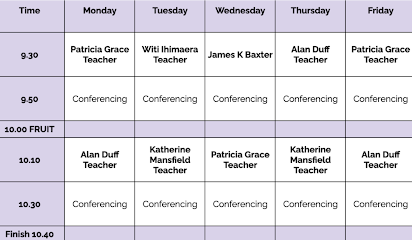
Timetabling Reading
As part of the Reading Practice Intensive course we are working on timetabling of our reading sessions. Previously I disclosed that I had been doing far too many group sessions with every single group every day. Now I have backed off and am trying to work on fewer sessions while still seeing my lower kids every day. It turns out that backing things off is not as easy as it sounded!
From my perspective it has been easier, but from the perspective of the tamariki, it has thrown them through a loop. I had to back off from some of the sessions to enable the change in "feel" in the classroom to settle the tamariki. It was an odd situation. You'd think less time with the teacher would work out better, but no. They found it hard to spend more time doing their mahi or independent tasks. I realised I had created sessions that they needed my help with (or they perceived they did) and having to do more of it without checking in with me was too hard.
We are getting there though. The last thing I need or want is tamariki that depend on me or any adult for approval before they can do the next task.
Regarding the independent tasks; I was already using all but literacy planet as part of the options for independent work. I also use spelling shed with lessons each week they take themselves through. I will be introducing Literacy Planet after I have settled into the teacher groups better and "set them free" with their mahi.
All part of the learning process - particularly with these kids who tend to expect work to be super easy and that if it requires even a moment's thinking, that Whaene Vicki will do it for them or write it for them!
I do reading the same time every morning - it works well and I don't have any ins and outs that affect that time slot. I am looking to rejig this in term two to have some days at different times to see how that works out and to change the daily timetable a bit. I am loathe to do this in the final weeks of term as it will unsettle the routine we have got into.
Friday, May 31, 2024
Manaiakalani Reading Practice Intensive - Planning a Reading Programme - Day 5
After last session's epiphany about my Guided reading, I kept doing what I was doing as I saw the next session was about planning the reading programme. I didn't want to rush ahead and then have to redo it all as I didn't hit the mark.
This session I have taken away several ideas that I will be working on, in the coming weeks. The biggest delight this week was the writing as reader session. I find writing my weakest pou in my whare of learning. It is hard. This activity is such a great way to add more modelling to my tamariki and improve their writing - all from their reading!
Friday, May 10, 2024
Manaiakalani Reading Practice Intensive - Guided Reading - Day 4
Guided reading is the mainstay of reading instruction in my classroom. However, I was checking every child's reading every time I saw them in guided reading. Doh! I have looked at my guided reading (GR) instruction from university and it wasn't very complete at all. So for the past five years I have been struggling to keep up with the groups and every reader every week. No wonder I have found it to be not my favourite part of the day. Probably not for the tamariki either.
The biggest epiphany is that I don't need to do this! I do have tamariki on the colour wheel which I will continue to work on intensively, however, I can now release the older and better readers and only do observations maybe fortnightly. Sigh. A lot of work over the years for probably little benefit for my tamariki and way too much work for myself. I think I might sit in the corner and cry later today.
I will be taking a closer look at the more formal note taking ideas from the rōpu and trying various options to see if it works for me or if I need to make changes. Currently I do anecdotal notes which end up all over the place unless I do a probe or other formal assessment.
Looking at the introduction of the texts for GR, I have probably been a bit loose in my preamble with regards to prior knowledge, and the examples of the more targeted questions and the choice of words was excellent.
Fluency is something we are working on currently. We have been recording ourselves, but I will now use the fluency rubric to get my tamariki to self assess and then discuss it with them. It will make them look more carefully at the way they are reading DURING their reading, rather than waiting for me to assess afterwards.
This is the first time I have been explicitly taught how to do comprehensive guided reading. This is my 6th year of teaching. I have found bits and pieces here and there about it, and have watched others, but this PLD session has been great on the practicalities of teaching reading and I will be changing up the way I do things as a result.
I found the Fountas and Pinnell Guided reading framework a good way of structuring my sessions, although I will be introducing the learning intention at the start of the session as well as touching on it during the lesson. I find the more you express the LI, the more likely the tamariki seem to be to understand what and why they are learning something.
Friday, April 5, 2024
Manaiakalani Reading Practice Intensive - Text Selection - Day 3
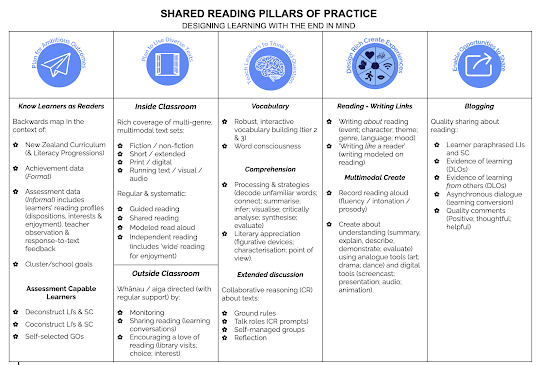
Another intensive day, this time about what texts we choose and why we choose them. We are working on the Inside Classroom pou of our pillars of practice (see below).
Having to do some activities with a tight timeline made me realise it isn't as hard as I can sometimes make it out to be! I often angst for hours over texts and then they are read and done in a few minutes and I wonder at how much time I wasted for the kids not to connect or to "get it" so easily it was almost unworthwhile. I put together a text set in just a few minutes which I will add to but will be using next term.
I realised over the past few weeks that I really have steered clear of poet
ry. As a poetry lover since I was a child I am absolutely frustrated at myself for the disservice I have done to my tamariki. I deliberately have chosen poetry to start of term 2. I am going to be using ones that evoke the senses which will also help them with the descriptive writing we are doing next term. I have chosen poems about events or situations they are familiar with and can use their prior knowledge to connect with. I have other writing about these same topics that will help fill any gaps they have and to give different perspectives on the subjects.
Another part of the kaupapa that resonated with me a lot this time was ensuring we were providing texts that gave tamariki the opportunity to see themselves, see others and to experience other worlds - mirrors, windows and sliding glass doors.
I work in a small rural type of town. We are a decile 2 school and our kids don't go a lot of places often, or have experiences that take them beyond their own small neighbourhood. We do cover a lot of te ao Māori as our tamariki are 85% Māori. They live in a Pākehā world however being only 30% of the town's ethnic make up (don't talk to me about where the 70%'s kids are going to school though!!). We teach Te Atiawatanga which is the way that our local iwi participate and interact with the world (most of our tamariki are part of this iwi). We ensure they know about local land wars, Parihaka and the rich Māori history of our rohe. They are somewhat closed off to the world out there though. They often haven't been out of the North Island, let alone the country. So ensuring they have meaningful interaction with texts of various forms about other people and cultures is vital, and helping them to figure out how Aotearoa fits in this world.
Putting my practice into a rubric to see what I am doing with the way I teach reading was interesting too. I do long texts often as read alouds of novels, where I read something like "The Wild Robot" to them purely for enjoyment, although I model what I am thinking and some new vocabulary occasionally. I cast this to my TV via a reading app and can see some of them reading along as I go. Others are drawing the scenes that I am reading about. They love it and so do I. Guided reading is completed each day but I was a bit slack on the shared reading. I often struggled with what to do with my older students but seeing today's example of shared reading made a few pennies drop so I will be incorporating more into my classwork for term 2. I'm excited! I also like the buddy reading. We already are focusing on how fluently we read and recording ourselves, so having a friend help them read better out loud in a safe environment will add to this immensely.
Another week chock full of learning and I'm sure I have more to talk about, but will catch up with my fellow RPI attendees at school and my mentor.
Friday, March 8, 2024
Manaiakalani Reading Practice Intensive - Know your Learners as Readers - Day 2
Day 2 was a very intensive day. I feel shattered at the end of it!
We had a quick look at our assessment data from the PAT Pānui Reading Comp testing. Three of my tamariki are incomplete: one was away and been away a nearly every day I scheduled to run it for him, then two just mucked around and gave answers and attitude in such a way I know they weren't taking it seriously. They will have the joy of resitting with a mentor watching over them.
I have always looked at the ARBs for maths, but no so much for reading. Having the opportunity to look more closely at these was good and I have many ideas for how to use them. The readings a short but varied. I rarely use poetry and that showed in the PAT test as a low area. They were unable to identify metaphors and to picture the scene in their heads and answer the questions correctly. I love poetry myself as my parents gave me poetry books as a child - why aren't I modelling this to my tamariki? Moving forward I will definitely be using these in my reading groups to create discussions and discover how the akonga are thinking and why they are answering the way they are.
My class has quite a few gaps and I'm glad I'm on this course to help me to plug those gaps and to ensure the success of my tamariki with reading.
I feel a little overwhelmed with the tracking sheet. It requires a lot of time to build up the data and then once it is full, the data needs to be tracked again in other ways at my school. When we get into using it though, we will have some evidence to drop the repetition and just link everything to the comprehensive tracker! Sooner rather than later would be a good outcome. It would be great if the rest of the school used these also as it would mean that as students move through the school we would have the data being tracked and what has been covered. We track students through HERO and know where they are up to, but it is only as good as the data being input. At the senior end we inherit the data from previous teachers and there can be gaps that aren't gaps or things marked off that need re-visiting.
I always give a WALT for my lessons and we discuss the Success Criteria (SC). The tamariki do have the opportunity to help decide what the SC should be, but often it may be only one sensible SC offered by them, but at least that gives them a hand and a feeling of co-creation. I will be working on trying to get more out of them though. The splitting down of the AO, LI and SC was a great exercise and one I hadn't thought about it. Also the backwards planning. Makes perfect sense. It's how I handle things in my own life - want to go on holiday? What do I need to do to get there in the months prior to leaving? Same with what the tamariki are expected to be able to do at the end of a unit or similar. So what do I need to do to get them there?? I LOVE THIS.
The dive into why we do assessment was interesting along with the 7 characteristics of expert teachers. The surprise was that establishing and maintaining high expectations with the learners effect size was so high. I think I do have high expectations, but am I making sure the tamariki know this? I will be taking steps to ensure that I am communicating this clearly, both at a class level and at an individual level.
Over the past two weeks I have used the supplied slide with inferencing work for reading times in my class. This has been a steady battle with teaching them to learn how to use it and the expectations it has on them and self management. The first week I did no group reading because my time was spent teaching them where, what, how and when to do the activities. My biggest struggle is the tamariki that came from the ipads and have little or no digital knowledge. I have several tamariki that have not used chromebooks before (from outside our school or using ipads) and that has been a learning curve for them that can monopolise time somewhat. Next thing, it's morning tea! There is also a lack of ability in quite a few to TRY new things. They sit, look and do nothing. Walking around the room, discovering tamariki that were zoned out and not saying they needed help, or not even made it onto my class website surely upped my steps for the week but showed a lot of "helplessness" this year in the cohort. "Someone will do this for me" also showed up with older students completing the work for those friends who didn't get beyond getting their device. I need to work through this and have responsibility and self reliance as a goal for them.
I am looking forward to using the template slide with the graphic organiser with the week's work to access, and having the tamariki settle into their reading more. The best thing is seeing that they have gotten books out of the library now - those titles that were in the best fit book choosing exercise! I re-ran the activity with books from inside my classroom - it was a race to find them on the shelves and to read them. This was an amazing result. I will continue to do this activity and vary it somehow to keep putting books in front of them to read and choose. I may get them to try choosing a book for a partner to read based on what they say they like and see if that gets titles in front of them to get excited about.
We are starting to write book recommendations with covers next week so that they can see what others like. I am going to work with the school librarian to do this in the library too. I think the teina would like to see that their tuakana liked a book as they model themselves and their behaviour on the older tamariki.
Tuesday, February 27, 2024
Does Kōtare actually enjoy reading?
A couple of days ago I conducted a reading survey on my tamariki. I have a mixture of year 4, 5 and 6 students (mainly 5/6) and this years' cohort is at a lower academic level than previous years. They are all eager to please though and despite a choppy start with my attendance at school, they have settled in relatively well.
Getting to know your tamariki is key to their education. Knowing what they like, who they are, what they bring to your kopa is essential and being able to plan around this knowledge needs to be evidence based. This survey via Manaiakalani is one way to get to know who your tamariki are as readers.
Prior to the survey I thought that my kids would not like reading nor read a lot. The exact opposite of myself. I read before I started school at 5 and read everyday - although the past couple of years had me put down fiction and pick up a lot more text style and science books. I am just getting back into reading fiction after the first day of RPI inspired me.
I had a battle with Google Sheets. As an experienced MS Excel user I find sheets frustrating. To add to that I lost part of my brain with covid two weeks ago and I am sorry to say that I have yet to find parts of it!! I struggled with putting the data into sheets and gave up with some graphs that made a great maths lesson for the kids on reading the results. So a win there as they had to figure out that things weren't in order column wise (and what was a column?) so they had to read carefully. They were fantastic and enjoyed the lesson both from a maths perspective and to learn from the data itself.
The results surprised me. I have one outlier who did skew some results. This tamaiti reads texts books for fun and scores in stanine 9 for everything in his year, and stanine 8 for the year higher.
6 didn't read anything which was sad, but lower than I thought it would be. They generally fell on the "liked reading at school" side which was a relief, but looking at the individuals who didn't like reading at school it was the poorer readers which I felt for.
I shared the titles of the books that they had as favourites and several were interested in trying reading the books that the others enjoyed so that was great. I will be starting a recommendation system in class where kids write reviews for others to read with the book and have it on display for others to see and perhaps be inspired to read.
Just under half the class does not have their own library card. Again, I was surprised that it was that high! I am getting forms from our mobile book bus that comes from our city library to school so that others can get one if they wish. I will encourage parents to sign them up.
I wonder if some filled it in, in such a way in order to please me though. I hope not. These tamariki hunger for attention and love which as a role model for reading, I hope to influence them that reading is awesome and worthwhile.